
Small Stakes Live Tournament Quiz: The Answers
Nice work finishing the quiz. Below you’ll find every question, the correct answer, and the reasoning behind it, because knowing why a play is right is what actually gets you to more final tables.
Quick Answer Key: Tap a Number to Jump to the Explanation
When there are payout implications, as a big stack, you should look to:
- A Play lots of pots against the other big stacks
- B Play few pots against the big stacks
Coach’s Take
You do not want to bust before the mid and short stacks. Due to this, you should look to play fewer pots against the other big stacks.
At the start of a tournament, there are essentially no payout implications.
- A True
- B False
Coach’s Take
Early in a tournament, you should not take payout implications into account.
UTG raises and the BB calls. Who has the range advantage on K-T-8?
- A UTG
- B BB
Coach’s Take
With hands like 88+ and AK-AT, UTG has a large equity advantage vs. BB’s range.
You should check more often when you have range advantage.
- A True
- B False
Coach’s Take
You should bet more when you have range advantage because you also have an equity advantage.
When you bet for value, you want your opponents to call.
- A True
- B False
Coach’s Take
When you bet for value, you want your opponent to call.
UTG raises to 3bbs and UTG+1 3-bets to 9bbs. On the button with 9-9 with a 60bb stack, you should:
- A Fold
- B Call
- C 4-bet to 24bb
- D Go all-in
Coach’s Take
When someone 3-bets an early-position raise also from early position, they should have a very strong range. 99 does not do well against the two premium ranges involved, so fold.
With 50bb effective stacks, you have 10-7s UTG. You should:
- A Fold
- B Call
- C Raise to 2.5bb
- D Go all-in
Coach’s Take
This hand is not strong enough to raise from early position.
With 20bb effective stacks, the cutoff raises to 2.5bbs and you have ATo on the button. You should:
- A Fold
- B Call
- C 3-bet to 6bb
- D Go all-in
Coach’s Take
With a short stack with a decently strong hand, plus fold equity against the villain’s opening range, the best option is to go all-in.
With 3,000 chips at 100/200, you have:
- A 12bbs
- B 10bbs
- C 15bbs
- D 20bbs
Coach’s Take
3,000 / 200 = 15, so you have 15 big blinds.
When deep stacked, when you are facing 2 limpers and decide to raise, what raise size should you use?
- A 3.5bb
- B 5.5bb
- C 7.5bb
Coach’s Take
Vs multiple limpers, you want to raise to 3.5bb + 1bb for each limper.
When everyone folds to you on the BTN, should you ever limp?
- A Yes
- B No
Coach’s Take
When you are folded to, you always want to enter the pot with a raise unless you are in the small blind.
When everyone folds to you on the button, which of these hands should you usually fold?
- A A2o
- B K6o
- C J5s
- D 84s
Coach’s Take
84s is too disconnected and weak to raise from the button.
You should defend wider as you face larger bets because your opponents are more likely to be bluffing.
- A True
- B False
Coach’s Take
You should defend tighter against larger bets because you have to risk more money to continue.
Your equity realization will be higher in position.
- A True
- B False
Coach’s Take
True, because when you get to act last, you will over-realize your equity.
When you are in the big blind facing a continuation bet, are low paired boards high-frequency or low-frequency check/raise situations?
- A High-frequency check/raise board
- B Low-frequency check/raise board
Coach’s Take
This is because you have the nut advantage, so you should check/raise frequently.
How Did You Do?
You have a strong grasp of small stakes tournament strategy. Time to sharpen the edges and start hunting bigger scores.
Solid fundamentals, but the questions you missed are exactly where chips are leaking on your way to the money.
You know the concepts, but applying them in real spots is costing you equity. Structured study will fix that fast.
Good news: you just found your biggest opportunity. Most players never figure out where their tournaments go wrong.
Free Download
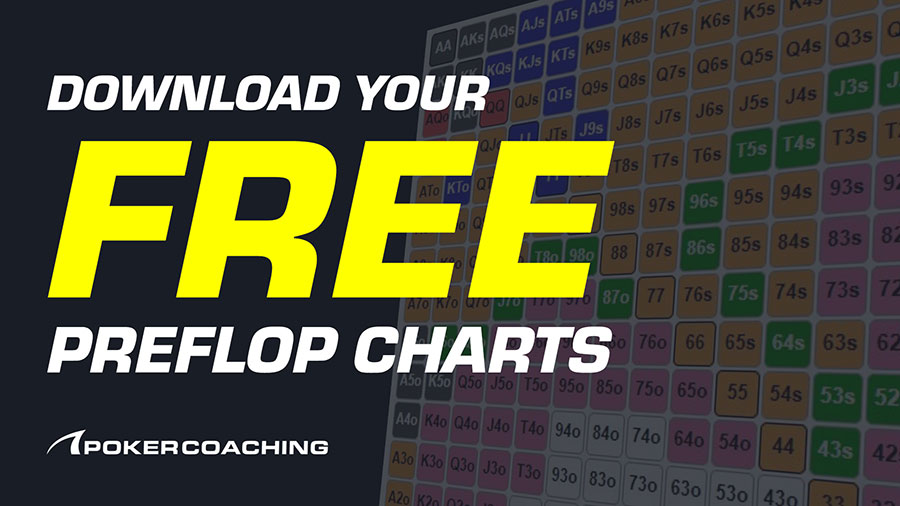
Get Your Free Preflop Charts
Many of the questions above came down to a single preflop decision. These free charts give you GTO-based ranges for every position and stack depth, so you always know whether to raise, call, shove, or fold before the flop. Download instantly.
Download Free Charts