












Hero
Others
0%
win
0%
0%
tie
0%
Calculating...
Display Status Message
Hero
Win: 0%
Tie: 0%


Poker Odds Calculator – Understand Equity and Make Better Decisions
If you want to improve at poker, you must understand odds and equity and make your decisions based on math instead of guessing.
This Texas Hold'em poker odds and equity calculator is a powerful tool designed to help you do exactly that.
Whether you're brand new to poker or an experienced player reviewing hands, this calculator instantly shows you how often a hand wins, how often it loses, and how your odds change as community cards are revealed.
It's one of the best ways to build real poker intuition and confidence.
What Is a Poker Odds Calculator?
A poker odds calculator (often called an equity calculator) is a tool that calculates the probability of each hand winning at showdown based on the cards you know.
Instead of guessing whether your hand is "good enough," the calculator answers questions like:
- How often does my hand win against my opponent's hand?
- How much equity do I have in the pot?
- How does the flop, turn, or river change my odds?
At PokerCoaching.com, we use a proven and accurate poker odds engine that evaluates all possible remaining cards to give you realistic win percentages — the same type of math used by top professional players.
This type of poker odds calculator is most commonly used for Texas Hold'em hand analysis and equity training.
How the Poker Odds Calculator Works
The calculator is designed to be fast, intuitive, and beginner-friendly. Here's how it works step by step.
Step 1. Enter Your Hole Cards
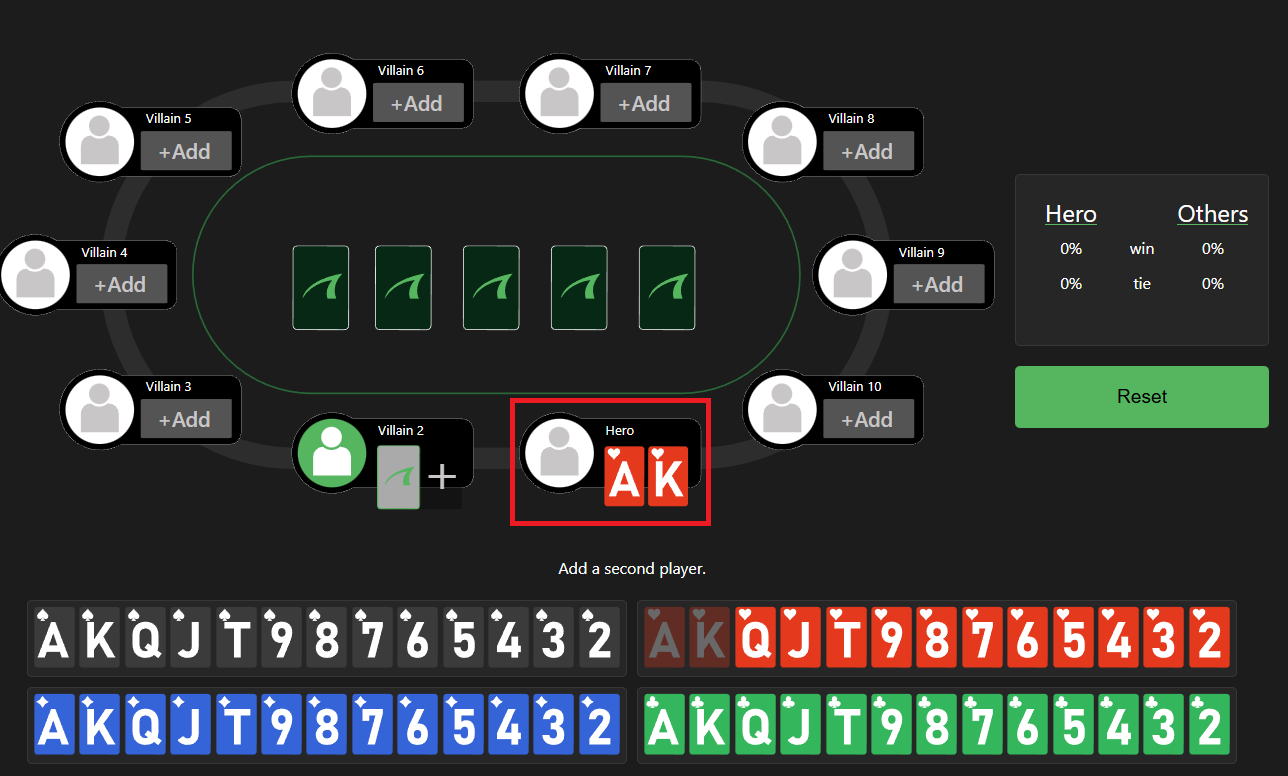
Start by selecting your two hole cards. These reflect your position in the current scenario and serve as the foundation for every equity calculation.
By choosing your exact cards, the calculator can accurately determine how your hand performs against your opponent's hand before any community cards are revealed.
Step 2. Add Opponent Hands
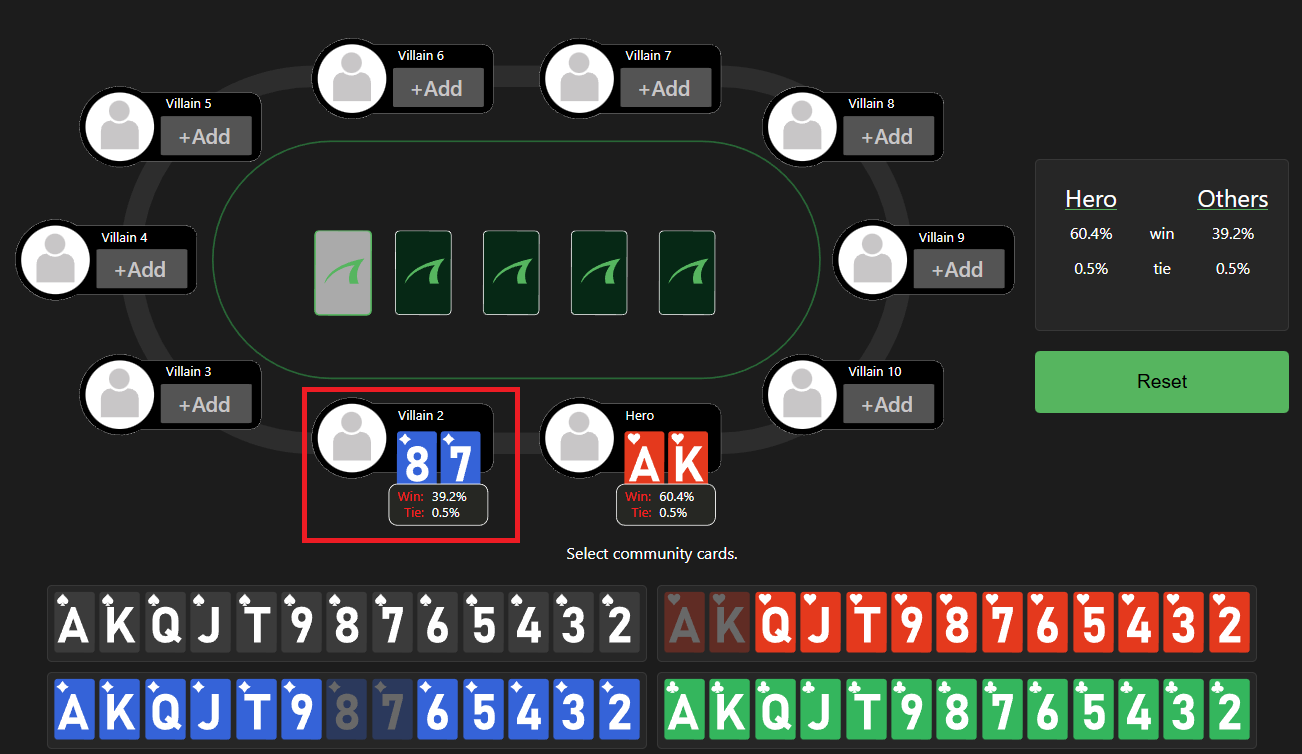
You can add one opponent or multiple opponents (up to a full table). This allows you to analyze heads-up pots, multiway pots, and tougher situations you'll see in real games.
As soon as you add cards for the second player, you will be able to see equity for the preflop situation, which will be updated automatically when you add additional players or community cards.
Step 3. Add Community Cards
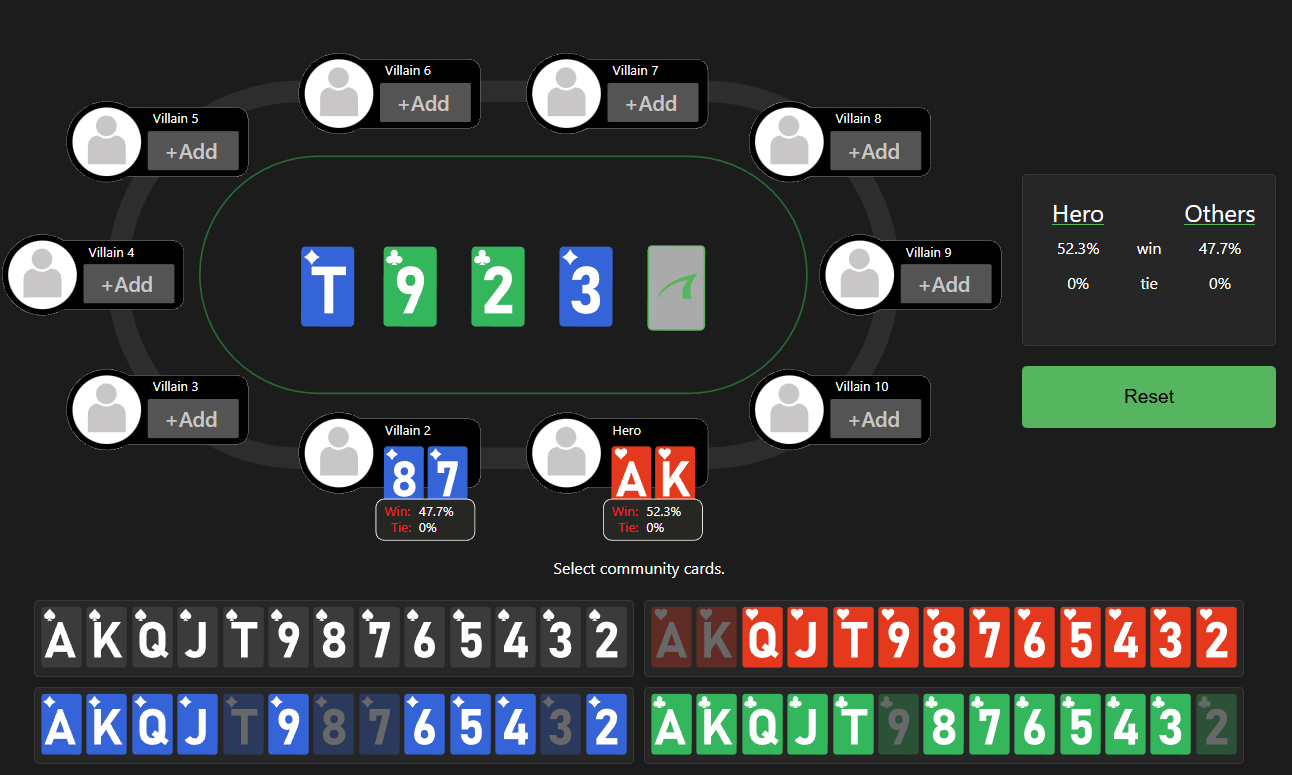
After seeing the preflop equity of all players in the initial stage, you can now add community cards and see how your chances of winning change across different runouts.
You can evaluate different scenarios on the flop and turn, and once the river is added, you'll see the final winner.
As each card is added, the calculator updates the odds instantly, so you will always see actual results for the current situation.
Step 4. View Instant Results
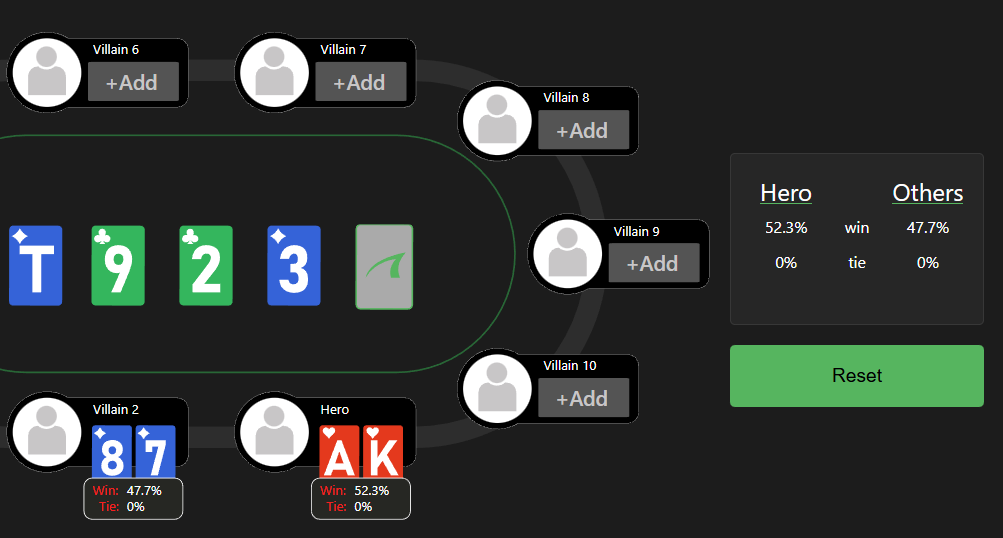
The tool automatically displays WIN and TIE percentages for each player under the cards, and shows overall results for HERO versus other players when you run multiway pots.
Behind the scenes, the calculator runs thousands of hand simulations to give you accurate equity results in real time.
Key Features of the PokerCoaching.com Poker Odds Calculator
- Instant Equity Calculations — See exactly how often a hand wins or loses based on the cards in play — no waiting, no refreshing.
- Multi-Player Support — Most real poker hands aren't just heads-up. This calculator allows you to analyze multiway pots, which is critical for improving decision-making.
- Street-By-Street Analysis — Watch how your equity changes from preflop to flop and turn. This is incredibly valuable for understanding why some hands lose value, and others improve as more cards are revealed.
- Clean & Easy Interface — No confusing charts or clutter. Just select cards and get answers.
- Perfect for Study & Review — Use it away from the table to review hands from recent sessions and build long-term intuition for poker math.
What Is Equity (And Why It Matters)?
Equity is your share of the pot based on how often your hand wins.
- If you have 60% equity, you should win the pot about 60% of the time.
- If you have 40% equity, you should win the pot about 40% of the time.
Of course, these are long-term numbers, so short-term variance can significantly influence your results. That being said, you will reach these averages over time in these situations.
Understanding equity helps you evaluate your pot odds and determine when calling is profitable by comparing it to poker outs. Decide whether betting or folding makes sense based on math, and stop relying on "feel" when playing.
This calculator makes equity visible and easy to understand.
How to Use the Calculator in Your Poker Training
Here's how we recommend using it as part of your study routine:
- Review your poker hands after each session
- Enter the exact cards and see if your decisions were mathematically sound
- Change the opponent's hands to explore alternative scenarios
- Study how different flops affect the same starting hand
The best way to understand poker odds is to see them in action — start by entering a real hand from your last session and explore how different cards change the outcome.
FAQ
- What are poker odds?
- Poker odds represent the probability of a certain outcome in a hand, such as how often your hand will win or how likely you are to hit a draw by the river.
- Why do I need to understand odds and equity?
- Understanding odds and equity helps you make profitable decisions over the long run by helping you determine when to call, bet, or fold.
- How can this equity calculator help me?
- This calculator instantly shows your win percentage and equity, helping you learn poker math faster and make better decisions by replacing guesswork with real data.
- Is the Poker Odds Calculator free to use?
- Yes. You can use the PokerCoaching Odds Calculator for studying and learning any time, completely free of charge.
- Can I use this during live or online games?
- Most poker sites prohibit real-time assistance tools during play. This calculator is intended for off-table study and review.
- Does this calculator guarantee winning?
- No poker tool can guarantee results. It provides probabilities, not certainty — but understanding probabilities is how winning players make better decisions over time.