
How to Play Poker: Step-by-Step Guide for Beginners [Free PDF]
Poker is a card game in which players bet on the strength of their hand, aiming to win the pot by either making the best hand at showdown or convincing all other players to fold.
In my experience coaching beginners, the players who improve fastest are not the ones who memorize the most theory. They are the ones who learn the rules, start playing, and focus on fixing the same handful of mistakes that every beginner makes.
Poker actually refers to many different game variations that we will touch on in this guide, but I will focus on Texas Hold’em, the world’s most popular poker variant, and take you from the basic rules to the strategy habits that actually make you money.
Download Printable Poker Rules PDF Guide
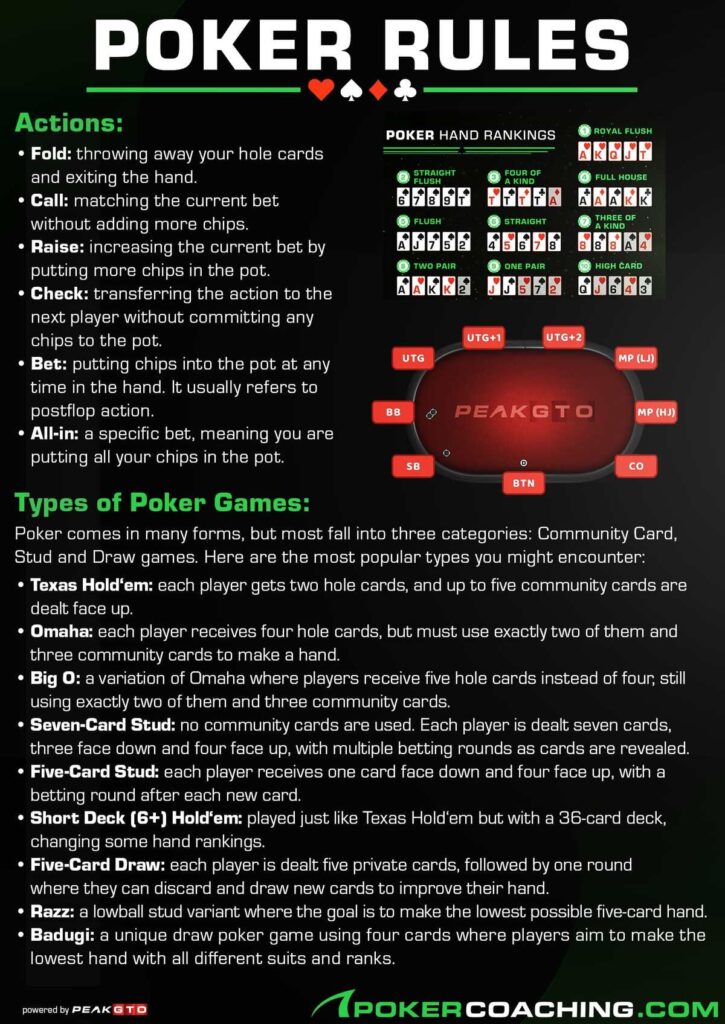
- How a No-Limit Hold'em Hand Works: Step by Step
- Poker Hand Rankings: What Beats What
- Texas Hold'em Actions: Fold, Call, Raise, Check, Bet
- Three Reasons to Bet in Texas Hold'em
- The Best and Worst Starting Hands in Poker
- Effective Stack Size
- Tournaments vs. Cash Games
- Online Poker vs. Live Poker
- Bankroll Management
- Essential Poker Terms for Beginners
- Is Poker a Game of Skill or Luck?
- Other Poker Games
- Poker Rules FAQ
How a No-Limit Hold’em Hand Works: Step by Step
No-Limit Hold’em is played with one standard 52-card deck. Your main goal in each hand is to win the pot, which is the total of all bets made. You win the pot if you make everyone fold before showdown, or if you have the best hand at showdown.
Before I get into every detail of how the game works, here is a quick overview of how a hand plays out from start to finish. This is what I wish someone had shown me before my first live game.
- Step 1. Two players post forced bets (the blinds) to start the pot.
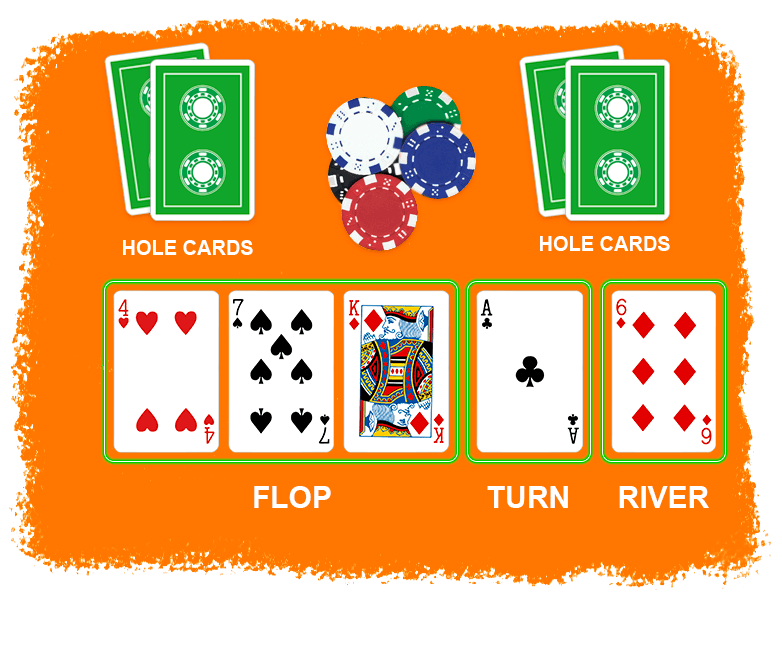
- Step 2. Every player receives two private hole cards face down.
- Step 3. A betting round takes place (preflop), where players can fold, call, or raise.
- Step 4. Three community cards are dealt face-up (the flop), after which another betting round follows.
- Step 5. A fourth community card is dealt (the turn), followed by the next betting round.
- Step 6. A fifth and final community card is dealt (the river), and a final betting round follows.
- Step 7. Remaining players reveal their cards (showdown), and the best five-card hand wins the pot.
If at any point only one player remains in the hand, that player wins the pot immediately without showing their cards.
Step 1: The Blinds Are Posted
Before any cards are dealt, the two players to the left of the dealer button post forced bets called the small blind and the big blind. In a $1/$2 game, the small blind is $1, and the big blind is $2. These bets start the pot and ensure there is always something to play for.
Blinds: The small blind and the big blind are two forced bets that are the first money in the pot. They ignite the action from other players.
Step 2: Each Player Receives Two Hole Cards
The dealer gives every player two private cards, face down. These are your hole cards. Only you can see them.
Step 3: Preflop Betting
Starting with the player to the left of the big blind and moving clockwise, each player chooses to call the big blind, raise, or fold. This is the preflop betting round.
Step 4: The Flop
After preflop betting, the dealer reveals three community cards face-up in the center of the table. These are shared by all remaining players. Another betting round takes place.
Step 5: The Turn
A fourth community card is revealed. Another betting round follows.
Step 6: The River
The fifth and final community card is revealed. The last betting round takes place.
Step 7: The Showdown
If more than one player remains after the final betting round, all remaining players reveal their hole cards. The player with the best five-card hand using any combination of their two hole cards and the five community cards wins the pot.
Showdown: When all betting rounds are complete, all remaining players compare their hands to determine the winner.
Watch Jonathan Little demonstrate two sample poker hands:
Poker Hand Rankings: What Beats What
You make your hand using the best five cards from your two hole cards and the five community cards. Suits rank equally. What matters is the hand type and the rank of the cards within it. From strongest to weakest:
| Hand | Description | Example |
|---|---|---|
| Royal Flush | A, K, Q, J, 10 of the same suit | A♥ K♥ Q♥ J♥ 10♥ |
| Straight Flush | Five consecutive cards of the same suit | 9♣ 8♣ 7♣ 6♣ 5♣ |
| Four of a Kind | Four cards of the same rank | A♥ A♣ A♦ A♠ K♥ |
| Full House | Three of a kind plus a pair | 9♣ 9♦ 9♠ 4♣ 4♦ |
| Flush | Any five cards of the same suit | K♥ J♥ 7♥ 5♥ 2♥ |
| Straight | Five consecutive cards of any suit | Q♥ J♣ 10♥ 9♦ 8♦ |
| Three of a Kind | Three cards of the same rank | 8♥ 8♣ 8♠ J♦ Q♦ |
| Two Pairs | Two different pairs | K♣ K♥ 9♦ 9♥ 10♦ |
| One Pair | Two cards of the same rank | 4♦ 4♥ K♣ J♥ 9♦ |
| High Card | No matching cards, no made hand | A♥ J♣ 8♦ 6♣ 2♥ |
For a complete breakdown of every hand, probabilities, tiebreaker rules, and strategy for playing each one, see our full poker hand rankings guide.
Can You Have a Tie in Poker?
More often than you might expect. When two or more players hold the same hand type, the highest cards within that hand determine the winner. For example, when both players have a flush, the player with the highest card in their flush wins. When both players have a pair, the higher pair wins. When every card is identical, the pot is split equally between the players.
FULL HOUSE OVER FULL OVER
J♥️J♣️J♦️2♥️2♣️ beats 2♥️2♣️2♦️J♥️J♣️
FLUSH OVER FLUSH
K♥️J♥️10♥️8♥️4♥️
beats
Q♥️J♥️10♥️8♥️4♥️
ranking card than a Queen.
STRAIGHT OVER STRAIGHT
J♣️10♥️9♦️8♣️7♠️
beats
10♥️9♦️8♣️7♠️6♥️
ranking card than a 10.
TRIPS OVER TRIPS
J♥️J♠️J♦️3♥️2♥️
beats
3♥️3♠️3♣️J♥️2♥️
ranking card than a 3.
TWO-PAIR
A♣️A♥️2♦️2♣️3♠️
beats
J♥️J♦️4♦️4♣️3♠️
ranking card than a Jack.
ONE-PAIR
3♥️3♠️6♦️5♥️K♥️
beats
2♥️2♠️3♠️A♥️K♥️
ranking card than a 2.
HIGH-CARD
Q♣️J♥️8♦️6♣️5♠️
beats
J♥️10♦️8♦️6♣️5♠️
ranking card than a Jack.
Watch the video below to learn more about how hand rankings work in practice:
Texas Hold’em Actions: Fold, Call, Raise, Check, Bet
In every betting round, each active player can take one of these actions when it is their turn:
Fold
Discard your hand and exit the hand. You lose any chips you have already put in the pot, but you risk no more. When should you fold? When your hand is unlikely to be the best, and calling or raising would cost more than the pot is worth.
Call
Match the current bet to stay in the hand. Calling makes sense when you believe your hand has enough equity to justify the price, or when you want to see the next card cheaply.
Raise
Increase the size of the current bet. Raising builds the pot when you have a strong hand, puts pressure on opponents with marginal hands, and gives you the initiative going into the next street.
Check
Pass the action to the next player without betting. You can only check when no one has bet yet in the current round. Checking does not cost you anything, but gives up the chance to build the pot or apply pressure.
Bet
Place chips in the pot when no one else has bet yet. The first bet opens the action and sets the price for everyone else to call, raise, or fold.
All-In
Bet all of your remaining chips. You can win the pot up to the amount of your all-in. If opponents have more chips, any additional betting goes into a side pot that you cannot win.
Three Reasons to Bet in Texas Hold’em
Before making any bet, ask yourself what you are trying to accomplish. There are three legitimate reasons to bet. Everything else is a habit, not a strategy. Every time I put chips in the pot, I know which of these three reasons applies.
1. For Value
You bet because you want worse hands to call. You have a strong hand, and you want opponents to put money in the pot with hands that lose to yours.
Example: You have top pair top kicker (A♠ K♣) on a board of A♥ 7♦ 2♣. Your opponent likely has a weaker pair, a draw, or nothing. You bet because you want them to call with those worse hands.
The mistake I see most often here: students value bet too small. If you bet $5 into a $20 pot with the best hand, you are giving opponents a great price to call with draws. Make them pay the correct price.
2. For Protection
You bet because you want hands that could beat yours on later streets to fold now. You are probably best at the moment, but the board is dangerous enough that giving free cards is a mistake.
Example: You have a buttom set (7♣ 7♦) on a board of 7♥ 9♣ 10♣. You are likely best right now, but any 8, J, or club can beat you on the next card. You bet to deny those draws a free look at the turn.
3. As a Bluff
You bet because you want better hands to fold. Your hand cannot win at showdown, but a bet can take the pot if your opponent folds.
Example: You have A♣ K♦ on a board of 9♥ 6♣ 3♦ 2♠ J♣. Your opponent checks with you. Your hand has no showdown value, but the Ace blocks your opponent’s top pair combinations, and the board does not connect well with typical calling ranges. A bet can win the pot even though your hand is worthless at showdown.
In my experience, most beginners bluff too often at the wrong times and not enough at the right ones. The right time to bluff is when you have a credible reason for your opponent to fold, not just when you have nothing. The best bluffs are semi-bluffs, where you also have a draw that could improve your hand even if called.
The Best and Worst Starting Hands in Poker
In my experience, the single most important preflop habit for a beginner is this: play fewer hands. Most beginners play too many starting hands because they want to be involved. But folding a weak hand before the flop costs you nothing. Playing a weak hand to the river costs you your entire stack on the bad days.
The Best Starting Hands
The best starting poker hands are strong big pairs and hands with the potential to make premium combinations like flushes and straights.
| Category | Examples | Why They Are Strong |
|---|---|---|
| Big Pocket Pairs | AA, KK, QQ, JJ, TT | Often the best hand before the flop and at showdown. Play for maximum value. |
| Strong Big Cards | AK, AQ, AJ, KQ | Make top pair with a strong kicker. AK is the best non-pair starting hand. |
| Medium Pocket Pairs | 99, 88, 77 | Reasonable showdown value. Can also make a set (three of a kind), which is usually a big winner. |
| Suited Aces | A♥8♥, A♣5♣ | When you make a flush, you hold the nut flush. This is a significant advantage. |
| Suited Connectors | 9♣8♣, J♦9♦ | Can make straights, flushes, and decent middle pairs. Best played in multiway pots. |
The worst starting hand mistake I see from new students is playing any two suited cards because they might make a flush. You will miss the flush more than 90% of the time, and when you miss, you have a bad pair or a bad kicker. The suited component adds about 3 to 4 percent more equity, which is not enough to justify playing hands that miss most boards.
The Worst Starting Hands
Some hands look playable but consistently lose money over time.
| Category | Examples | Why They Lose |
|---|---|---|
| Junky Connected Cards | 8♥6♣, 8♣4♦ | Same problem as above. The flush hits rarely, and when it does, it is often a low flush. |
| Junky Suited Cards | J♦3♦, Q♣4♣ | Same problem as above. The flush hits rarely, and when it does it is often a low flush. |
| Big and Little Cards | Q♥2♠, K♥4♣ | You are frequently dominated by opponents holding the same big card with a better kicker. |
| Unconnected Low Cards | 8♣2♦, 7♥3♣ | Almost nothing on these boards is good for you. These are folds in virtually every situation. |
Keep in mind that even a premium hand can become the wrong hand to play in the wrong spot. If you hold A♣T♣ and face significant action before it is your turn, your hand may not be strong enough to continue. Context matters as much as card strength.
Watch Jonathan Little go through starting hand examples:
Range: The combination of hands a player may possibly be holding at any given time. Thinking in terms of ranges rather than specific hands is one of the most important skills in poker.
View our full preflop charts here.
Effective Stack Size
In poker, you can only lose the chips you have in front of you. If you sit at a table with $100 and your opponent has $10,000, the most either of you can win or lose in a single hand is $100. The smaller of the two stacks determines the maximum risk for both players. That is your effective stack size.
The poker strategy you use changes significantly depending on your stack depth. A player with 10 big blinds plays very differently from a player with 100 big blinds.
Calculating Your Stack in Big Blinds
Divide your chip count by the current big blind to find your stack depth in big blinds.
| Stack Size | Big Blinds | What It Means |
|---|---|---|
| Short-stacked | 25 or fewer | Limited postflop options. Push/fold becomes your primary strategy. |
| Medium-stacked | 26 to 50 | Some postflop play, but stack depth still constrains big multi-street bluffs. |
| Big-stacked | 51 to 100 | Full range of strategic options. Standard cash game depth. |
| Deep-stacked | 101 or more | Implied odds become very important. Speculative hands increase in value. |
Example: With 10,000 chips at 100/200 blinds, you have 10,000 / 200 = 50 big blinds (medium-stacked).
Example: With 1,200,000 chips at 50,000/100,000 blinds, you have 1,200,000 / 100,000 = 12 big blinds (short-stacked).
Learn more about effective stack sizes and how they change your strategy.
Tournaments vs. Cash Games
No-Limit Hold’em is played in two formats with meaningfully different structures and strategies. One practical difference I always explain to new students: in a cash game, every chip has a direct dollar value. If you have $200 in chips at a $1/$2 table, you have $200. In a tournament, your chips represent only your survival in the field, not a cash equivalent. This changes decisions in fundamental ways.
| Cash Games | Tournaments | |
|---|---|---|
| Buy-in | Variable. Rebuy anytime. | Fixed entry fee. Rebuy only if allowed early. |
| Chip Value | Chips equal real money directly. | Chips have no direct cash value. Survival matters. |
| Blinds | Fixed. Do not increase. | Increase at set intervals. Players must adapt. |
| Payout | Leave anytime, take your chips as cash. | Roughly 1 in 7 players cash. Winning can pay 50x your buy-in. |
| Key Skill | Expected value decisions. Chip EV equals cash EV. | ICM awareness. Stack survival and payout jumps affect correct decisions. |
Tournament Strategy at the Bubble
The bubble is the stage just before players make the money. Correct play here changes dramatically depending on your stack:
- Big stack: Apply pressure to the middle and short stacks. Win small pots frequently to build further. Your goal is always to win the tournament, not just to cash.
- Middle stack: Apply pressure to shorter stacks while avoiding confrontations with big stacks that can eliminate you. If a big stack at your table is playing passively, take advantage by attacking their blinds.
- Short stack: Look for the best spot to get your chips in the middle. Your goal is to double up and get back to a playable stack size, not just to survive into the money for a small payout.
Online Poker vs. Live Poker
The fundamentals of the game are identical whether you play live or online poker. Both formats reward the same core skills. What differs is the environment and the pace.
| Live Poker | Online Poker | |
|---|---|---|
| Hands per hour | 25 to 30 hands | 60 to 80 hands, more with multi-tabling |
| Reads and tells | Physical tells, body language, betting patterns | Timing tells, betting patterns, player tendencies |
| Multi-tabling | Not possible | Can play multiple tables simultaneously |
| Hand history | No automatic tracking | Full hand histories for review and analysis |
| Difficulty | Generally softer at similar stakes | Generally tougher. A $0.05/$0.10 online winner usually beats $1/$2 live winner. |
In my experience playing both, the biggest adjustment from live to online is pace. Online, you see three times as many hands per hour, which is great for learning but demanding on focus. When I started playing online after years of live poker, I had to actively slow down my decision-making. The interface makes it easy to click fold or call on autopilot, and that is exactly when you make your worst decisions. If you play online, treat every decision as if it costs the same as a live decision. It does.
Bankroll Management
Your bankroll is the money you set aside exclusively for poker, separate from your everyday expenses. One of the most important habits you can build early is treating your bankroll as its own separate fund. Using poker money for other expenses, or adding to it from personal funds when you run bad, is how players go broke.
Why Bankroll Rules Exist
The reason for keeping a large bankroll relative to the stakes is variance. In No-Limit Hold’em cash games, even a winning player can lose 15 to 20 buy-ins in a stretch of bad cards. Not because they played poorly, but because the short-term variance in poker is enormous. Without a cushion, you go broke during a normal downswing before your skill edge has time to show.
I have seen talented players quit the game because they failed to separate their poker bankroll from their living expenses, had a bad month, and had to stop playing. The bankroll rules exist to protect you from that outcome.
| Format | Recommended Minimum | Example |
|---|---|---|
| Cash Games | 3,000 big blinds | Playing $1/$2? Keep at least $6,000 as your bankroll. |
| Tournaments | 50 buy-ins | Playing $100 tournaments? Keep at least $5,000 in your bankroll. |
As your bankroll grows or shrinks, move up or down in stakes accordingly. Do not let your ego keep you in games your bankroll cannot support. Moving down stakes is not failure. It is the responsible choice that keeps you in the game long enough for your skill to compound.
Essential Poker Terms for Beginners
Here are the most important terms you will encounter when learning to play poker. For the complete poker glossary, see our full poker terms guide.
Is Poker a Game of Skill or Luck?
In any single hand, luck is a significant factor. The cards you are dealt and the community cards that run out are random. But over thousands of hands, skill dominates. The players who consistently win are doing so because they are making better decisions, not because they are running luckier.
Here is a simple way to think about it. If you pick a card at random from a full deck, the odds of a red card are exactly 50%. Now remove all the diamonds. The odds of a red card drop to 33%. Nothing changed about the cards themselves. Your knowledge of the deck is what gives you the advantage. Poker works the same way. The more accurately you assess probabilities and opponents, the better your long-term results.
In my experience coaching players at every level, the question is never whether poker rewards skill. The question is how long you are willing to put in the work before skill starts to outweigh variance. The answer is: faster than most people expect, if you study correctly.
Other Poker Games
Texas Hold’em is the most popular poker variant worldwide, but there are many different poker variations worth learning. Here is a quick summary of each:
- Texas Hold’em: 2 hole cards, 5 community cards. The most played poker game in the world, both live and online.
- Pot Limit Omaha (PLO): 4 hole cards (you must use exactly 2), 5 community cards. More action than Hold’em. Second most popular variant.
- Pot Limit Omaha Hi-Lo: PLO, where the pot is split between the best high hand and the best qualifying low hand.
- Short Deck Hold’em: Played with a 36-card deck (2s through 5s removed). A flush beats a full house in this variant.
- Razz Poker: Low hand wins. Best possible hand is A-2-3-4-5. Pairs hurt you rather than help.
- 7 Card Stud: No community cards. Each player receives 7 individual cards, some face up and some face down.
- 5 Card Stud:
- 5 Card Draw: The classic home game. Each player gets 5 cards and can exchange up to 3 for new ones.
- Badugi: A lowball draw game where the goal is four cards of different suits and ranks. No pairs, no flush cards.
- Big O:
Casino poker games (played against the house rather than other players) include Pai Gow Poker, Ultimate Texas Hold’em, 3 Card Poker, 4 Card Poker, and Caribbean Stud.